

Insights
Ben Boissevain speaks at technology and corporate finance events, is quoted in the press on M&A transactions and is an author at TechCrunch.

6/28/26 Airwallex announces $320 million fundraise and CFO hire
“Bringing in a CFO out of a growth-equity fund who already knows the business from the inside is an IPO-readiness signal, not a routine hire," Ascento Capital Invest founder Ben Boissevain told American Banker. "You hire that profile when your next conversations are with public-market investors, not when you're still finding product-market fit."

12/11/25 Airwallex raises $330 million to expand into US, Europe
Ben Boissevain, founder of Ascento Capital Invest, told American Banker that the $330 million raised by Airwallex "provides a long runway so they have no pressure to sell or IPO, which is the best position to be in for valuation negotiations. A well-established international company like Airwallex would choose to go the VC funding route to set a fresh reference price in anticipation of an IPO or a sale to a strategic acquirer," he said. "An increase in valuation also helps attract talent in a competitive market with Stripe, Rapyd and Revolut."
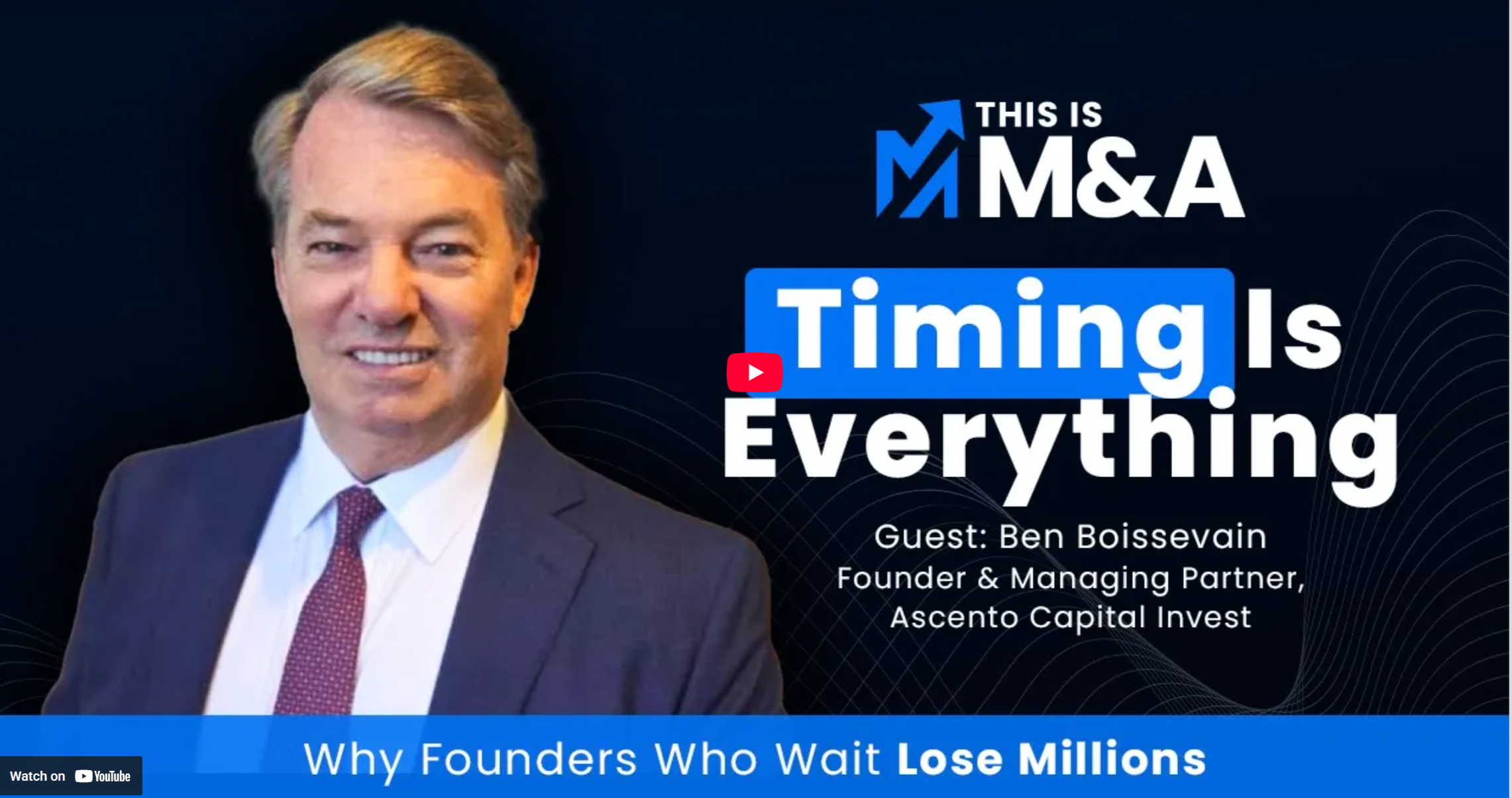
11/20/25 Stop Quoting 2021 Multiples. Here’s Your Real Value with Ben Boissevain | This Is M&A
In the latest episode of This Is M&A, Ben Boissevain, Founder of Ascento Capital Invest, joins host Steven Monterroso to discuss why waiting for “perfect” market conditions could be the most expensive mistake a founder ever makes.

10/20/25 Apple Is a Master of Acqui-Hire as It Quietly Grabs Top Talent in A.I. Race
Unlike traditional acquisitions, the main goal of an acqui-hire is talent, not technology. “Acqui-hires let Big Tech firms rapidly capture specialized talent while avoiding the cost, regulation and complexity of traditional acquisitions,” Ben Boissevain, founder of Ascento Capital Invest, an investment bank specializing in advising on tech M&A deals, told Observer. “[They were] specifically got used in recent A.I. acquisitions because the breakthrough ideas come from a few talented top engineers.” Ben also noted that “Apple may surprise us with a large acquisition of a company like Perplexity, which is valued between $14 billion and $18 billion”, speculating on the high-flying A.I. answer engine maker.

6/25/25 Built to Sell: Achieving Top Dollar Exits in 2025" - Ellis Law Group at NY Tech Week
At NY Tech Week’s Built to Sell panel, Ben Boissevain and other experienced M&A professionals shared practical insights on how founders can position their companies for high-value exits in 2025. The discussion focused on what today’s strategic buyers are prioritizing, why early preparation matters long before a formal sale process, and how thoughtful deal structuring can improve outcomes for both buyers and sellers.

8/3/23 Operational and finance tips for early-stage startups in a tough market
There is no question that this market is tough for tech startups. The market meltdown today can be compared to the dot-com meltdown in 2000 and the Great Recession meltdown in 2009. But even in tough markets, there are many survivors. This article explores survival tips for startups — for both operational and corporate finance. For the many companies that do survive, there will be an opportunity to grow faster since fewer competitors will fight for market share and corporate finance conditions will improve.

7/27/23 Buying and Selling Privately-Held Companies: Process and Key Deal Terms
In this discussion, Ben Boissevain, Founder and Managing Partner at Ascento Capital Invest, breaks down what actually drives outcomes in private company transactions. He explains why sellers who prepare early, cleaning up financials, tightening operations, and creating competitive tension, consistently achieve stronger results. Rather than focusing only on headline valuation, Boissevain emphasizes that structure and timing determine whether a transaction is a win long after it closes.
8/30/22 Key issues you should consider before signing an international merger deal
Despite the war in Ukraine, accelerating inflation and increasing interest rates, the tech sector has still seen M&A in the U.S. In the first half of 2022, large tech deals included Microsoft acquiring Activision Blizzard for $69 Bn, Google buying Mandiant for $5.4 Bn, and Elon Musk bidding $44 Bn for Twitter.
7/18/22 Mark-to-market to arrive at a realistic valuation and improve your fundraising odds
Valuations in 2022 have been falling like a rock as the war in Ukraine rages, inflation skyrockets and the Fed tightens the screws. Fintech firm, Klarna, whose valuation plummeted 85% to just $6.7 billion from $45.6 billion, is an extreme example of this. Klarna’s woes are also related to the “buy now, pay later” subsector falling out of favor, but it’s not alone. Almost all tech companies are seeing their valuations decline — the Nasdaq is now more than 31% below its ATH on November 19, 2021.
7/26/21 How to prepare for M&A, your most likely exit avenue
Despite the plentiful headlines about mega billion-dollar M&A transactions, record IPOs and the rapid growth of SPACs, small deals will continue to be the most likely exit for the vast majority of tech startups. In the over 30 years I’ve worked on M&A at White & Case, Barclays and my current firm Ascento Capital, I have seen too many startups that are not prepared for an exit via a merger or sale.
6/17/21 Funding, M&A and Valuation Data Points to Navigate the Dynamic AI Sector
The AI sector is experiencing exponential advances in technology with a new revolutionary developments almost daily. Investment in the tech sector is down significantly, but investment in the AI sector has only decreased slightly by comparison. M&A in the sector is very active with large technology companies the most acquisitive. Valuations are astronomical, which is typical for a large new exciting sector, but coming down to earth slowly. In this dynamic environment, there are practical steps founders and investors can take now to capitalize on the AI sector.

5/6/21 Selling a Company for Maximum Valuation: Critical Steps and Timing
Selling a company is a process not an event. There are many steps on a long, winding road in a process that culminates in a closed transaction. The M&A process can be divided into four phases: Preparation, Marketing, Selection and Closing. The process generally takes four to six months, although for reasons explored below, the timing can vary.
4/26/21 A Practical Guide to the Intricacies of the M&A Valuation of Tech Companies
The theoretical metrics of company valuations are well known: compare similar public companies, review precedent M&A transactions and throw in a DCF model for good measure. Then how does this theoretical valuation model account for Facebook's acquisition of WhatsApp in 2014 for $19 Bn when WhatsApp had $20 M in revenue, a 950x revenue multiple? Why is Airbnb worth $31 Bn, which is more than Hilton at $27 Bn. Why is Uber worth $72 Bn, which is more than GM at $58 Bn?
3/14/26 Negotiating Working Capital: Maximizing M&A Valuation
The working capital issue can surprise a seller and cost the seller millions of dollars. Many business owners assume the purchase price for their business will be based on a multiple of some financial metric, e.g. revenue or EBITDA. This is generally true, but a buyer typically requires a minimum amount of “working capital” on the balance sheet when they buy the business to ensure there are no immediate liquidity issues. A buyer does not want to pay twice, once to buy the business and then have to inject capital at the closing of an M&A transaction to keep the business running.
1/21/21 How to Maximize How Much You Keep When You Sell Your Company
Congratulations you are the majority shareholder and just received several offers to sell your company for $100 million! The question is, at the end of the day, how much will you keep? A lot depends on how well you structure and negotiate the transaction. In the example below, if you sell your company for $100 million, you net $16 million at the closing. But do not despair, this is a worst case scenario.
1/11/21 When is the Right Time to Sell a Business to Maximize Valuation?
Timing is the most important factor in maximizing valuation in the M&A process as well. There are multiple cycles at work in M&A in the technology sector: capital flows, competition, technology, and economics. It is critical to follow each cycle carefully to determine when to sell. It is also important to honestly examine your company's strengths and weaknesses and thus the probability of growing into a billion dollar unicorn.
1/7/21 How to Conduct a Successful M&A Sell Side Process
Selling a company is an exciting process. Years of effort building value in a company culminate in a six month process to sell the company. Getting the M&A process right is critical to extract maximum value. "Conduct" is the right word since there are many moving parts in the M&A process. This article will help you ensure that all the parts work together harmoniously for a smooth, efficient and successful M&A process.
11/11/20 How to Structure Effective Earnouts
An "earnout" is an acquisition payment mechanism where a portion of the purchase price of the selling company will only be paid by the Acquirer if the Seller attains agreed-upon performance goals after the closing. Well-structured earnouts allow growing companies to increase their sales price and incentivize the Seller's management team to stay with the Acquirer after the closing of a transaction. By contrast, poorly structured earnouts reduce the Seller’s value to the Acquirer, demotivate management, and result in litigation.
10/4/20 Process, Selection, and Strategic Trends in AI, FinTech, and SaaS
Mergers and acquisitions (M&A) remain a critical vector for corporate growth and technological adoption. This analysis provides a comprehensive overview of investment banking M&A advisory services, detailing the rigorous sell-side M&A investment banking process and offering a strategic view of M&A trends in AI, FinTech, and SaaS.